Romania -- August 1999The Jews of Sighetu-MarmatieiLocated on the border with Ukraine in Maramures County, Sighetu-Marmatiei is a city of 40,000 surrounded by rural communities that are the home of one of the most intact peasant cultures of Europe. It was our base for the second part of our visit to Romania. I mentioned to Alex Lazin, 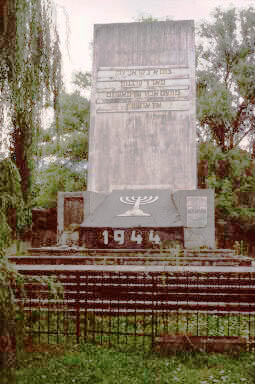 our
guide and host, that I was interested in learning what had happened to the Jews in this area,
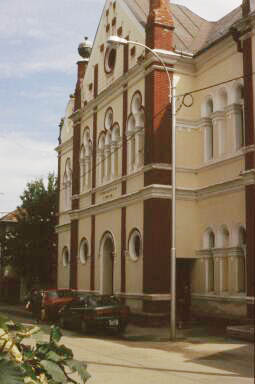
and as we went out for our first walk he kept pointing to the buildings as we walked, and pointing
out "Evreica house." It took a little while for me to realize that he was pointing to Jewish
homes, and he was identifying them as such by their design. After awhile
we came to a monument with Hebrew writing and a large date: 1944. And
later we came to the Jewish Cemetery and wandered around through the weeds
and gravestones until a watchman put us out. our
guide and host, that I was interested in learning what had happened to the Jews in this area,
and as we went out for our first walk he kept pointing to the buildings as we walked, and pointing
out "Evreica house." It took a little while for me to realize that he was pointing to Jewish
homes, and he was identifying them as such by their design. After awhile
we came to a monument with Hebrew writing and a large date: 1944. And
later we came to the Jewish Cemetery and wandered around through the weeds
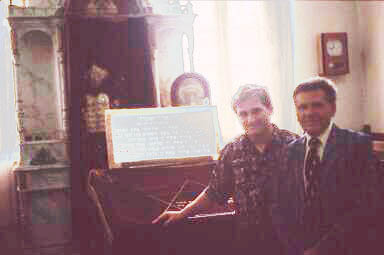
and gravestones until a watchman put us out.Another morning, as we were heading out of town to visit monasteries and villages in the countryside, Alex stopped downtown at a closed synagogue. I thought it might be a good time to try out my most ambitious line of Romanian, so I asked Alex, "Onde pot gasi un rabin care vorbeste englezeste?" (Where can I find a rabbi who speaks English?) I was goofing. I learned it as a goof, and I didn't expect it to be a useful phrase. But it was. Alex disappeared. When he came back in a few minutes, he beckoned me to follow him to the side of a building and into an office, where he introduced me to Hari Markus, the newly-seated 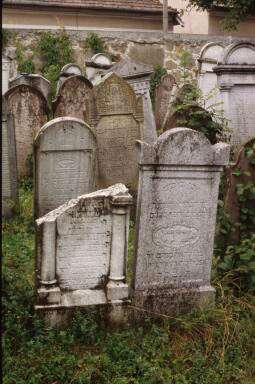 president
of the Sighet Jewish community. About sixty, retired engineer. From Iasi,
a somewhat larger and more important city in the northeast, but his wife
was from Sighet and wanted to come back, and here they were. president
of the Sighet Jewish community. About sixty, retired engineer. From Iasi,
a somewhat larger and more important city in the northeast, but his wife
was from Sighet and wanted to come back, and here they were.We talked for awhile. He would have preferred to speak French or German, but his English wasn't bad. We went over to the synagogue. He explained that it had been a Sephardic Synagogue, while most of the Romanian Jews were Ashkenazi. A small room was being used for weekly services; the synagogue proper was undergoing serious restoration. Hari's son Sorin, an excellent English speaker, joined us. From the two of them I got the following outline of what had happened to the Jews of Sighet. Until the second world war, Hari told me, Sighet had a Jewish majority. About 20,000 Jews lived in Sighet proper, and many more in the countryside. The houses Alex had pointed out as "Evreica houses" had been among the most prosperous. Maramures was part of "Greater Romania" taken over by Hungary at the beginning of the war and under Hungarian administration throughout the war. In 1944, all the Jews were shipped to Aushwitz and other concentration camps. Most perished; some came back after the war. Of those that resettled in the area, almost all emigrated to Israel. Romanian Jews make up the second largest contingent of 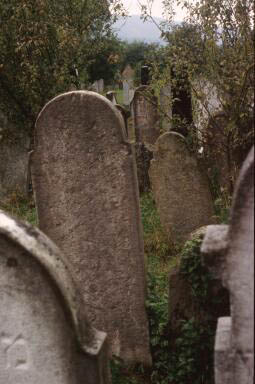 the
Israeli population. Jews were pressured to emigrate; during the Ceausescu
era, Israel paid Romania $50 for every Jew who moved to Israel. the
Israeli population. Jews were pressured to emigrate; during the Ceausescu
era, Israel paid Romania $50 for every Jew who moved to Israel.Today there are about 100 Jews in Sighet. There are also Gypsy, Hungarian and Ukranian minorities. Everyone gets along, Hari told me.
Video: "Onde pot gasi..." |
 Because, they told me, when they come to round up the Jews, they'll
take us, too. The Holocaust makes us Jews.
Because, they told me, when they come to round up the Jews, they'll
take us, too. The Holocaust makes us Jews.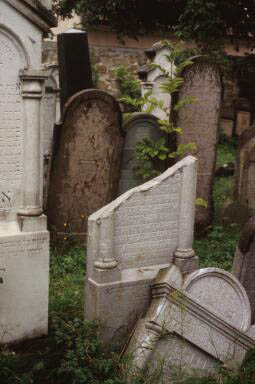 I had a similar experience in the Hebrew Cemetery at Sighet. A part
of the past came into focus for me.
I had a similar experience in the Hebrew Cemetery at Sighet. A part
of the past came into focus for me.Back to Romania Journal | The Full Deck
Copyright 2005 Peter Rashkin. All rights reserved. |